“Is It Harder for South Asians to Build Muscle?” is a question a lot of people start asking when they’re training consistently, eating well, and still not seeing the progress they expected.
Research has found some average differences in body composition between South Asian and Western populations. South Asians can carry a higher percentage of body fat at the same BMI, have lower levels of lean mass, and face a higher risk of insulin resistance and type 2 diabetes.
You may have heard this described as the “thin-fat” South Asian phenotype: someone can look relatively slim based on weight or BMI while still carrying more body fat and less lean mass than expected.
But none of this means South Asians cannot build significant muscle.
It means your starting point may be different, and blindly following a generic workout or diet plan may not always be the best approach.

Why Body Composition Matters for South Asians
BMI only looks at your weight compared with your height. It does not tell you how much of that weight comes from muscle or fat.
That distinction can matter more for South Asians.
Recent UK Biobank research comparing South Asian and White European adults of similar age, sex, height, and weight found that the South Asian group had lower muscle volume and higher levels of several types of body fat.
Other studies have found similar patterns, including lower lean mass and skeletal muscle alongside higher body fat at comparable BMI levels.
So if two people weigh the same and have the same BMI, they may still be starting from very different places when their goal is to build muscle.
That is why simply chasing a number on the scale is not always helpful. For many South Asians, improving body composition by building more muscle while managing body fat can be a much better goal.
What About Insulin Resistance?
South Asian populations also have a higher risk of insulin resistance and type 2 diabetes, although there are many factors involved and this does not apply equally to every person.
You will sometimes see this turned into a much simpler claim online: “South Asians are insulin resistant, so they cannot build muscle as easily.”
The science is not that simple.
Skeletal muscle plays a major role in how the body handles glucose, and having more muscle can be helpful for metabolic health. Resistance training can also improve insulin sensitivity while increasing muscle size and strength.
What we cannot confidently say is that being South Asian creates a fixed biological limit on how much muscle you can build.
Your training history, diet, protein intake, sleep, recovery, genetics, age, and overall health all matter too.
So rather than thinking, “My body is working against me,” the more useful question is: “Is my plan actually built for where I’m starting?”
How Should South Asians Train to Build Muscle?
You do not need a completely different type of strength training because you are South Asian.
The fundamentals still matter.
Your muscles need a reason to adapt, which means resistance training that gradually becomes more challenging over time. Your program also needs enough training volume to stimulate growth without giving you more work than you can recover from.
That might mean adding weight, increasing reps, improving technique, or gradually doing more quality work over time.
The important word is gradually.
Doing random hard workouts and leaving the gym exhausted is not the same as following a muscle-building program.
You need to know what you are doing, track it, and give your body enough time to improve.
Protein Matters More Than Most People Think
Training gives your muscles the signal to grow. Protein gives your body the building blocks it needs to respond.
Research on resistance training suggests that protein intake around 1.6 grams per kilogram of body weight per day is a useful target for supporting muscle growth for many adults, although individual needs can vary.
This can take a little more planning if your South Asian diet is naturally high in rice, breads, lentils, and vegetable dishes but lower in concentrated protein.
That does not mean you need to stop eating South Asian food.
It may simply mean building meals differently.
You might add more Greek yogurt, paneer, tofu, soy, lentils, beans, protein powder, eggs, fish, chicken, or other protein sources depending on how you eat.
The goal is not to replace your culture with a bodybuilding diet. It is to make sure your existing diet gives your body what it needs to support your training.
Can You Build Muscle on a Vegan South Asian Diet?
Yes.
Being vegan can make hitting a high protein target require a little more planning, but a plant-based diet does not rule out serious muscle growth.
Research has shown that high-protein vegan diets can support increases in muscle size and strength during resistance training. In one controlled study, young adults following high-protein vegan and omnivorous diets achieved similar increases in lean mass and muscle size during a 10-week training program.
A newer systematic review found the picture is more mixed depending on the type of plant protein used, but soy performed similarly to animal protein for muscle mass in the studies reviewed.
In practice, the biggest issue is usually not whether plant protein “works.” It is whether you are eating enough total protein and getting it from useful sources consistently.
What This Can Look Like With the Right Plan
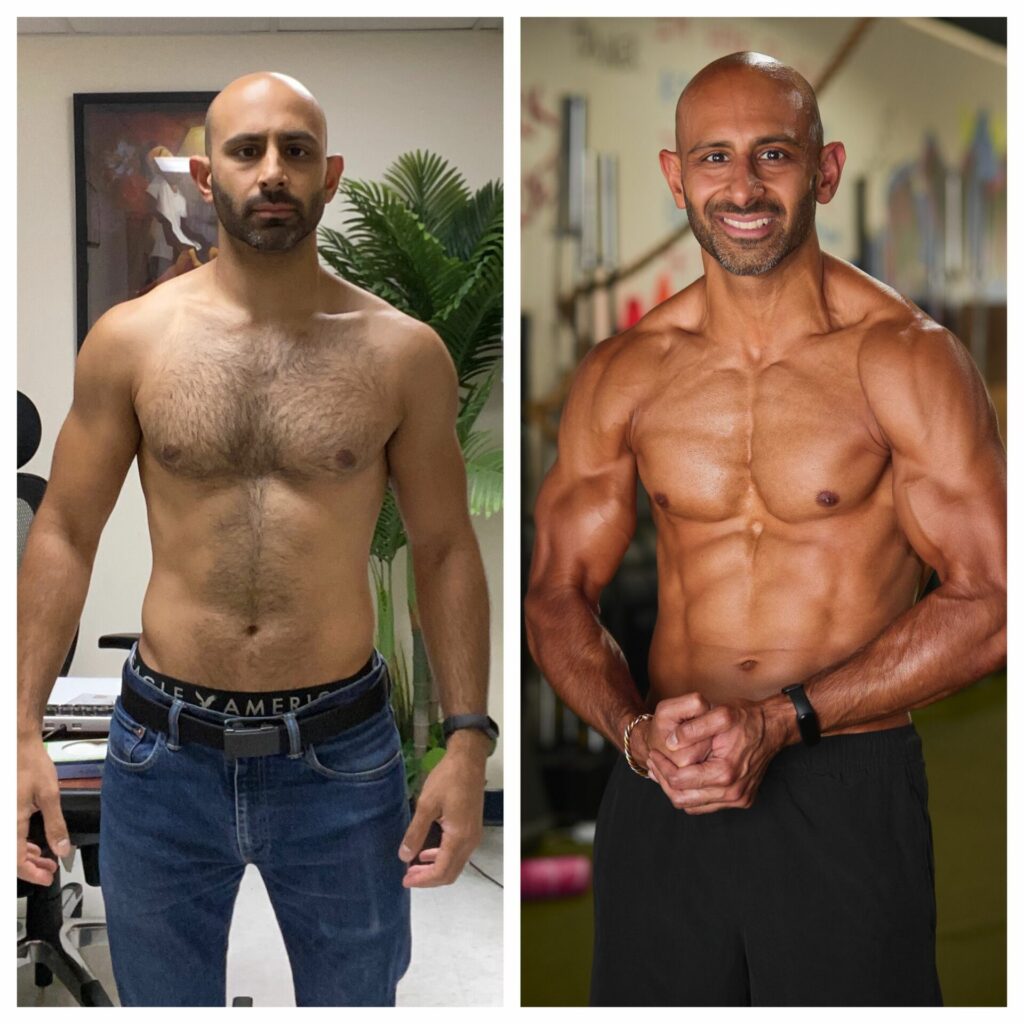
Dr. Sumeet Bahl is a good example of what is possible.
Sumeet had been lifting weights since he was younger and later became vegan in 2017. By the time he started working with KMAK at 40, his goal was not simply to exercise more. He wanted to take his physique further while continuing to follow a fully vegan lifestyle.
KMAK built his approach around his body, diet, long-term goals, training, and nutrition. According to his client story, he went on to build a physique that surpassed what he had achieved in his teens and 20s while remaining vegan.
Read Sumeet Bahl’s full story here.
His story does not prove that every South Asian will respond in exactly the same way. What it does show is that being South Asian and eating a fully plant-based diet are not automatic barriers to building visible muscle.
The Problem Usually Isn’t Your South Asian Body
There are real population-level differences in body composition and metabolic health that are worth understanding.
But that is very different from saying South Asians are simply bad at building muscle.
For most people, the more useful things to focus on are whether their training is progressive, whether they are eating enough protein, whether their calories match their goal, and whether they are recovering well enough to actually adapt.
The plan should account for your starting point rather than using your background as an excuse for poor progress.
If you’ve been training hard without seeing the muscle growth you expected, KMAK Fitness builds personalized training and nutrition plans around South Asian clients, including vegetarian and vegan diets.
To find out what your own muscle-building plan could look like.